Evaluating Rainbow Drawn: A Practical Look at This Outlined Display Type
Selecting the right typeface for a design project often feels like navigating a maze of conflicting priorities. You need legibility, but you also crave personality. You want something that stands out, yet it must remain readable across various mediums. In this landscape, Rainbow Drawn emerges not as a generic solution, but as a specific stylistic choice with distinct characteristics. It is an outlined display font that brings a hand-drawn, playful energy to any layout. For designers and content creators aged 20 to 50 who are constantly evaluating visual assets, understanding where this font fits—and where it might fall short—is crucial for making informed creative decisions.
This evaluation aims to provide a balanced perspective on Rainbow Drawn. We will explore its aesthetic qualities, compare it against broader categories of display typography, and discuss the practical tradeoffs involved in using outlined letterforms. The goal is not to declare it the "best" font overall, but to help you determine if it is the right tool for your specific project needs.
Understanding the Aesthetic of Rainbow Drawn
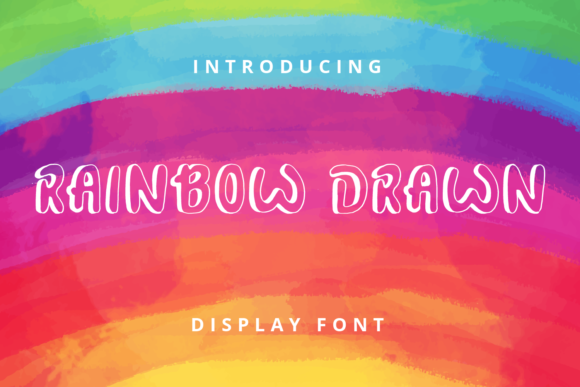
At its core, Rainbow Drawn is defined by its outline structure. Unlike solid fill fonts that rely on weight and density to create impact, this typeface uses negative space and contour lines to define its shapes. This approach immediately signals a sense of informality and creativity. The "drawn" aspect suggests imperfection, human touch, and organic movement, which contrasts sharply with the rigid precision of geometric sans-serifs or the formal elegance of traditional serifs.
The name itself hints at versatility, though the primary asset here is its cool, outlined display nature. Display fonts are designed to be read at large sizes—headlines, posters, banners, and titles—rather than in long paragraphs of body text. Rainbow Drawn excels in these high-visibility roles because its open structure allows it to grab attention without overwhelming the viewer’s eye. When used correctly, it adds a layer of texture and depth that solid fonts often lack.
However, the "rainbow" moniker does not imply that the font comes with built-in color variations. Rather, it suggests a vibrant spirit that pairs well with colorful palettes. The outlines act as containers for color, allowing designers to experiment with gradients, multi-colored fills, or even transparent backgrounds that integrate seamlessly into complex illustrations. This makes it particularly appealing for projects that require a cheerful, energetic, or youthful tone.
Comparing Outlined Fonts to Solid Alternatives
To truly appreciate Rainbow Drawn, it helps to compare it with other common approaches to display typography. The most direct comparison is with solid-weight display fonts. While a heavy bold sans-serif commands authority and stability, an outlined font like Rainbow Drawn communicates approachability and fun. If your brand identity leans toward corporate seriousness, financial stability, or medical professionalism, a solid serif or sans-serif would likely be a safer choice. The outlined style can appear too casual or juvenile in those contexts.
- Solid Display Fonts: Offer maximum legibility and a sense of permanence. They work well in low-contrast environments and ensure readability from a distance.
- Outlined Display Fonts (Rainbow Drawn): Offer visual lightness and stylistic flair. They excel in high-contrast settings and allow for creative manipulation of color and shape.
- Handwritten Scripts: Provide a personal, signature-like feel but often sacrifice consistency and ease of reading compared to structured outlines.
Rainbow Drawn sits comfortably between rigid geometric forms and erratic script styles. It retains enough structure to be recognizable as standard alphabet characters while introducing enough variation to feel custom-made. This balance makes it more versatile than many novelty fonts, which can become visually exhausting after prolonged exposure.
Practical Applications and Best-Fit Scenarios
Determining when to use Rainbow Drawn requires looking at the context of the message. Because it is a display font, it should never be used for body copy. Trying to read a paragraph set entirely in an outlined typeface causes eye strain due to the reduced contrast and the cognitive load required to process the gaps in the letters. Instead, reserve it for headlines, subheads, logos, and short phrases.
Consider a local bakery launching a new line of colorful cupcakes. A headline reading "Sweet Treats" in Rainbow Drawn would reinforce the product’s playful and artisanal nature. The outlines could be filled with pastel gradients, enhancing the visual appeal of the marketing material. Similarly, for a children’s educational app, this font could make learning materials feel less intimidating and more engaging.
In contrast, imagine a tech startup aiming to convey innovation and sleek efficiency. A clean, minimalist sans-serif would better align with their brand values. Using Rainbow Drawn in this context might send mixed signals, suggesting a lack of seriousness or a focus on whimsy over functionality. The key is alignment between the font’s personality and the project’s goals.
Limitations and Tradeoffs
No font is perfect, and Rainbow Drawn has specific limitations that designers must account for. First, scalability can be an issue. At very small sizes, the thin lines of an outlined font may disappear or merge with the background, rendering the text illegible. Always test your chosen font size before finalizing a design.
Second, kerning and spacing require careful attention. Outlined letters often have different visual weights depending on their shape. Some characters may appear heavier or lighter than others, requiring manual adjustment to achieve a balanced look. This is less of a concern with uniform solid fonts, where every character occupies the same amount of visual space.
Third, accessibility is a critical consideration. Users with visual impairments or dyslexia may find outlined text more difficult to read than solid text. High contrast between the outline and the fill color is essential, and avoiding overly decorative variations within the font family ensures that the base design remains accessible. Designers should always provide alternative text or consider pairing Rainbow Drawn with a highly legible sans-serif for secondary information.
Decision Factors: When to Choose Rainbow Drawn
If you are evaluating whether to add Rainbow Drawn to your toolkit, ask yourself a few strategic questions. Does your project prioritize emotional connection over strict formality? Is the target audience responsive to playful, informal visuals? Will the font be displayed at a size where its outlines remain clear and distinct?
If the answer to these questions is yes, Rainbow Drawn is likely a strong candidate. It offers a unique way to inject personality without resorting to cliché clipart or overly complex illustrations. Its outlined nature provides a modern twist on classic typography, bridging the gap between traditional print aesthetics and digital vibrancy.
However, if your project demands universal clarity, professional gravitas, or extensive body text, you should look elsewhere. There are countless excellent serif and sans-serif options that serve these purposes far better. The value of Rainbow Drawn lies in its specificity; it is a specialized tool for creating mood and atmosphere, not a general-purpose workhorse.
Integrating Rainbow Drawn into Your Workflow
For those who decide to incorporate Rainbow Drawn into their designs, thoughtful integration is key. Pairing it with complementary elements can enhance its impact. Consider using simple, clean backgrounds to let the outlined letters stand out. Avoid busy textures or patterns behind the text, as they can interfere with the legibility of the outlines.
Experimentation with color is another powerful technique. Since the font relies on outlines, you are not limited to black text. Try filling the letters with bright, contrasting colors or using gradient overlays to create a dynamic effect. Just ensure that there is sufficient contrast between the fill and the background to maintain readability.
Additionally, consider how Rainbow Drawn interacts with other typographic elements. Using it alongside a neutral, understated font can create a pleasing hierarchy. The outlined display font draws the eye, while the simpler companion font provides necessary context and detail. This combination leverages the strengths of both styles, resulting in a cohesive and professional design.
Final Thoughts on Evaluation
Choosing a font is rarely about finding a single "correct" answer. It is about selecting the most appropriate tool for the job at hand. Rainbow Drawn offers a distinct aesthetic that can elevate designs intended to be fun, engaging, and visually striking. Its outlined style provides flexibility and charm, making it a valuable addition to any designer’s library.
By understanding its strengths, limitations, and ideal use cases, you can make confident decisions about when to deploy this font. Whether you are designing a poster, a logo, or a digital banner, taking the time to evaluate how Rainbow Drawn fits your specific needs will result in more effective and impactful communication. Remember, the best design choices are those that align clearly with the message you intend to convey.