Hank Over: A Practical Evaluation of a Bold Display Typeface
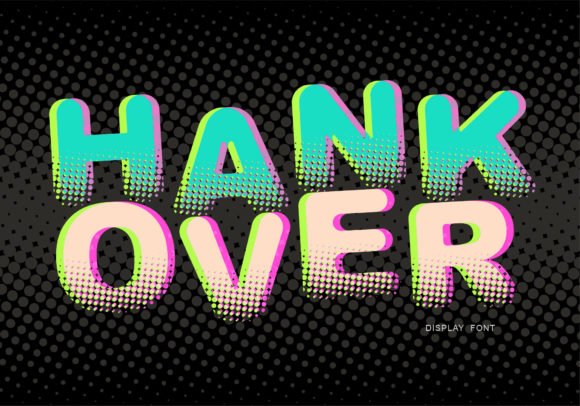
In the crowded landscape of digital typography, finding a font that commands attention without sacrificing readability is a constant challenge for designers and marketers. Many typefaces promise impact but deliver visual noise, while others prioritize legibility at the cost of personality. Hank over enters this space as a specialized tool, specifically engineered to function as an awesome faded display font. It is not designed for body text or long-form reading; rather, it is crafted to serve as a focal point in posters, flyers, and high-impact print materials. This evaluation examines what makes Hank over distinct, how it performs in professional workflows, and who might find it most valuable.
Understanding the Design Philosophy
The term "faded" in typography often refers to a gradient effect or a distressed texture that simulates wear and tear. However, when applied to a font like Hank over, it suggests a specific aesthetic direction: one that balances boldness with a sense of age, texture, or atmospheric depth. The font is characterized by its heavy weight and distinctive letterforms, which are intended to stand out immediately upon viewing. Unlike standard sans-serif or serif fonts that aim for neutrality, Hank over is opinionated. It brings a narrative quality to any design, suggesting themes of ruggedness, nostalgia, or industrial strength depending on the context.
This design approach requires careful handling. Because the font is visually dense and textured, it cannot be used lightly. Its strength lies in its ability to act as a headline anchor. When placed correctly, it draws the eye and sets the tone for the entire composition. For professionals creating event posters, album covers, or promotional flyers, this immediate visual hierarchy is crucial. The font does not whisper; it announces.
Key Characteristics and Visual Impact
- Bold Weight: The primary characteristic of Hank over is its substantial stroke width. This ensures visibility from a distance, making it ideal for large-format printing such as billboards or stage backdrops.
- Faded Texture: The built-in fading effect provides depth without requiring complex graphic manipulation in software like Photoshop or Illustrator. This saves time during the design process while maintaining a consistent aesthetic.
- Display-Only Suitability: The font is strictly a display typeface. Its intricate details and heavy presence make it unsuitable for paragraphs of text, where it would become illegible and visually exhausting.
These features combine to create a typeface that feels both modern and timeless. The "awesome" quality mentioned in its description stems from its versatility within the display category. It can evoke a vintage poster feel just as easily as it can suggest a contemporary urban aesthetic, largely depending on the color palette and layout choices made by the designer.
Practical Applications in Professional Design
To understand the true value of Hank over, it is helpful to look at how it functions in real-world scenarios. For freelancers and small business owners, efficiency is key. A font that reduces the need for extensive post-processing allows for faster turnaround times. If a client needs a flyer for a weekend festival, using a font that already incorporates texture and fade effects means the designer can focus more on layout and less on layer styles.
Consider a scenario where a musician is designing a gig poster. The goal is to convey energy and raw emotion. Standard fonts might require additional graphic elements—grunge overlays, noise filters, or gradient maps—to achieve the desired mood. With Hank over, the emotional tone is embedded in the letters themselves. The designer can simply place the text, choose a complementary background, and the message is delivered with inherent attitude. This directness is a significant advantage in fast-paced creative environments.
Similarly, educators and bloggers who occasionally create infographics or social media graphics benefit from the clarity and impact of such a font. While their primary content may be informational, the headers need to capture attention in a scroll-heavy feed. Hank over provides that punch. It breaks the monotony of clean, minimalist designs that dominate many digital platforms, offering a touch of grit that can make educational material feel more engaging or urgent.
Integration into Existing Workflows
For agencies and marketing teams, consistency is paramount. Using a unique font like Hank over can help establish a brand identity, particularly for brands associated with music, sports, food, or lifestyle sectors. However, integration requires strategic planning. Because the font is so dominant, it should be used sparingly. A common best practice is to pair Hank over with a simple, neutral sans-serif font for secondary information. This contrast ensures that while the headline grabs attention, the details (dates, locations, prices) remain easy to read.
- Pairing Strategy: Combine Hank over with lightweight sans-serifs to balance the visual weight.
- Spatial Awareness: Allow ample negative space around the text. The faded edges and bold strokes need room to breathe to avoid looking cluttered.
- Color Contrast: Ensure high contrast between the font and the background. The fading effect can reduce legibility if the background is too busy or similar in tone to the text.
Evaluating Quality and Long-Term Value
From an E-E-A-T (Experience, Expertise, Authoritativeness, and Trustworthiness) perspective, the value of a font lies in its technical quality and longevity. Does the file render cleanly across different devices? Are the glyphs complete? For a display font, these technical aspects are critical. A poorly rendered font can undermine even the best design, appearing pixelated or jagged on high-resolution screens.
Hank over appears to be constructed with professional standards in mind. The fading effect is integrated into the font file itself, which means it scales consistently. Whether printed on a business card or a banner, the texture remains proportional. This reliability is essential for serious hobbyists and professionals alike, who cannot afford to spend hours fixing rendering issues. The font’s ability to maintain its integrity across various sizes contributes to its long-term utility. It is not a trend-based gimmick that will look dated in six months; instead, its classic display structure gives it staying power.
Potential Limitations
No tool is perfect, and Hank over has clear boundaries. Its primary limitation is its narrow use case. It is not a general-purpose font. Attempting to use it for emails, blog posts, or document headers will likely result in poor user experience and reduced readability. Designers must resist the urge to overuse it. Additionally, the faded style may not align with every brand identity. Corporate entities seeking sleek, minimal, or corporate-friendly aesthetics might find Hank over too aggressive or informal. It is best suited for projects where personality and impact are prioritized over subtlety.
Who Should Consider Hank Over?
Identifying the right audience for Hank over helps clarify its practical application. It is particularly well-suited for:
- Event Promoters: Those creating posters for concerts, festivals, or club nights where high energy is required.
- Freelance Graphic Designers: Professionals looking for quick, impactful solutions for client projects that demand strong visual statements.
- Small Business Owners: Entrepreneurs in competitive markets who need their signage and advertisements to stand out physically and digitally.
- Content Creators: Bloggers and YouTubers who want to add a distinctive flair to their thumbnails and promotional banners.
For these groups, Hank over offers a blend of aesthetic appeal and functional efficiency. It reduces the barrier to entry for creating professional-looking designs, allowing those with limited design training to produce results that look polished and intentional.
Conclusion
Typography is more than just choosing words; it is about choosing how those words are seen. Hank over serves as a powerful instrument in this process, offering a unique combination of boldness and texture that cuts through visual clutter. While it is not a versatile all-rounder, its specialization is its greatest strength. By understanding its limitations and leveraging its strengths, designers and creators can use Hank over to produce stunning posters, flyers, and prints that resonate with their audience. In a world saturated with generic content, having access to tools that allow for authentic, impactful expression is invaluable. For those willing to respect the font’s nature, Hank over delivers endless possibilities for creative exploration.